Service

Answer repeat team questions
without interrupting your best people.

Turn SOPs, docs, and repeat internal questions into one clear place the team can ask for answers and see the source.

A strong first project for teams losing time to repeat questions, buried documentation, or knowledge stuck in one person.
Get the first-build recommendation
The Bottlenecks
Repeat interruptions

the same few people still get asked questions that should already be documented

Buried answers

the docs exist but are slow to search and easy to mistrust in the moment

Knowledge bottlenecks

useful process knowledge still lives in a few heads instead of a dependable answer layer

Weak doc usage

people ask a person first because the documentation does not feel easy to trust

Inspectable proof build

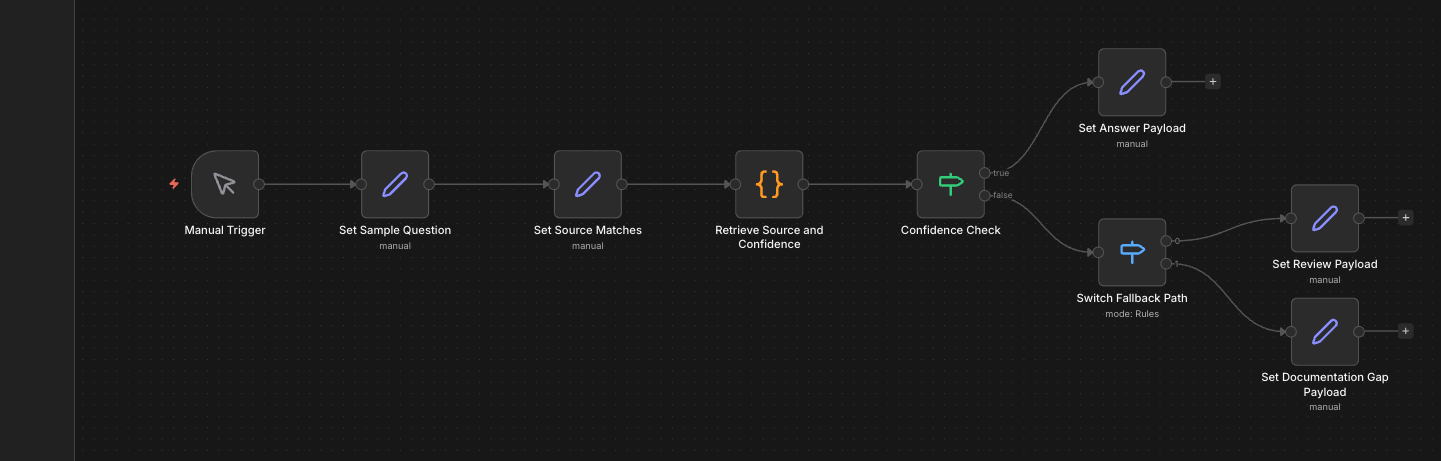
Inspect the answer path before the scope details.

The real n8n canvas and sourced answer states land near the top, so the proof reads as operational before the deeper explanation.

n8n canvas for the Rivet Flow internal support assistant proof workflow
Shipped pattern · anonymized

Internal answer layer

The first build connected the existing SOPs and docs to one answer entry point, with source checks and a visible fallback when the documentation was weak.

Bottleneck

A small group of experienced team members kept getting interrupted because the docs existed but were hard to search and easy to mistrust.

First shift

The team started getting answers in the flow of work with the source attached.

Build note. Weak or missing source material stayed visible instead of being covered up by a confident answer.

The Process
01

We gather the source material.

Your docs, SOPs, and internal notes are connected so the system has one place to pull answers from.

02

The team asks a question.

People use a simple Slack or web entry point instead of interrupting the same person over and over.

03

They get an answer with the source.

The response points back to the original document so the team can trust what they are seeing.

What changes in practice

The team gets one place to ask repeat questions.

Answers can show up through Slack or a lightweight web view, depending on what fits the team best.

The answer points back to the source.

People can see where the information came from instead of trusting a black box response.

Good docs get used more often.

Existing SOPs and knowledge become easier to find instead of staying buried.

Before you ask about pricing
Usually live in about a week

When the main documents already exist, the first version can be launched quickly.

Built around the docs you have

The goal is to make the current SOPs and notes easier to use.

Flags weak answers instead of bluffing

If the source is weak or missing, the system can route the question for review.

Good fit

The team asks the same questions often enough that interruptions are clearly costing time.

There is already a useful base of docs, SOPs, or notes to work from.

You want people to self-serve more often without hiding the source behind a black box answer.

Not a fit yet

The core documentation barely exists yet, so the first problem is documentation cleanup rather than answer delivery.

You need a much broader internal knowledge overhaul across several teams before a focused first build will help.

Investment
$3,500-$6,000
Typical first build

A first internal answers setup connected to your docs, with a simple Slack or web entry point.

Typical first build includes

Connect the core docs or SOPs that already answer the repeat questions

Set up one simple place where the team can ask for an answer

Return the answer with the source so people can trust what they are reading

Above this range when

Custom quote when the docs are incomplete, scattered, or low-trust, or when multiple teams need separate answer paths.

Software and API costs stay separate. Optional support can be added after launch.

Get the first-build recommendation
Common questions
How long does this usually take? +
Most first versions are live in about a week once we have the source docs and know where the team wants to ask questions.
What do you need from us to get started? +
Usually a set of the key documents, a sense of the repeat questions the team asks most often, and access to the tool where people will use it.
Will this replace our docs? +
No. It is built to make your existing docs easier to use.
How does the team use it day to day? +
Usually through a simple Slack command or lightweight internal page where they ask a question in plain language and get a sourced answer back.
How do you keep the answers accurate? +
The system answers from the documents you choose and points back to the source. If the source is weak, the gap stays visible.
Related insight

Internal knowledge assistant vs knowledge base software

Use this page if the team already has docs but still interrupts the same people for answers.

Read the knowledge assistant comparison
Get the first-build recommendation

Tell us what needs fixing first.

One bottleneck, the current tools, and where work gets dropped is enough to start.

We reply within 1 business day with fit, the likely first build, and a realistic range.